
Introduction to Tissue Repair
Tissue repair refers to the biological process that restores the structure and function of damaged tissues following injury. This process is essential for maintaining tissue integrity and involves two main mechanisms:
- Regeneration: complete restoration of normal tissue architecture and function
- Connective tissue deposition (scarring): replacement of damaged tissue with fibrous tissue
The balance between these two processes depends on the type of tissue and the severity of the injury.
Classification of Tissues Based on Regenerative Capacity
Tissues in the human body are classified into three categories according to their ability to proliferate and regenerate:
1. Labile Tissues (Continuously Dividing)
Labile tissues are composed of cells that are constantly renewed. These tissues have a high regenerative capacity due to active stem cell populations and the ability of some mature cells to proliferate.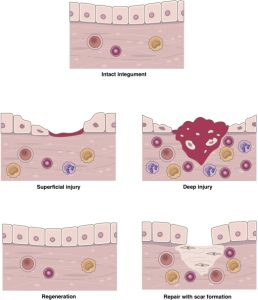
characteristics:
- Continuous cell turnover
- Rapid regeneration after injury
- Dependence on stem cells and proliferating mature cells
Examples:
- Skin (epidermis)
- Bone marrow
- Gastrointestinal (GI) epithelium
2. Stable Tissues (Quiescent Tissues)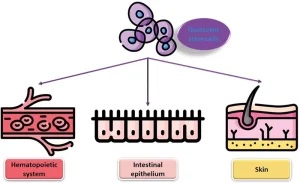
Stable tissues consist of cells with low proliferative activity under normal conditions. However, these cells can re-enter the cell cycle and regenerate in response to injury.
Key characteristics:
- Minimal cell division at baseline
- Moderate regenerative potential after injury
Examples:
- Liver
- Kidney
- Pancreas
3. Permanent Tissues (Non-Dividing)
Permanent tissues are made up of cells that have lost the ability to proliferate. As a result, these tissues cannot regenerate after injury.
characteristics:
- No regenerative capacity
- Damage leads to irreversible loss of function
- Healing occurs exclusively through scar formation
Examples:
- Brain (neurons)
- Heart (cardiac muscle)
Mechanisms of Regeneration
Regeneration occurs continuously in labile tissues and to a limited extent in stable tissues. It does not occur in permanent tissues.
Examples of regenerative responses:
- Removal of one kidney leads to compensatory hypertrophy and limited hyperplasia in the remaining kidney
- Partial hepatectomy (removal of part of the liver) triggers significant liver regeneration
Scar Formation (Fibrosis)
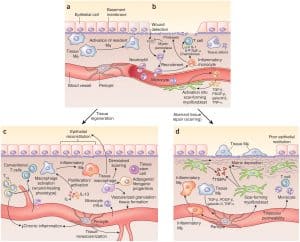
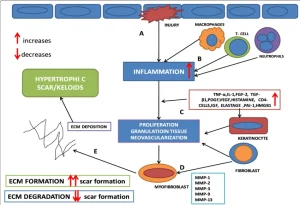
When complete regeneration is not possible, tissue repair proceeds through scar formation. This process replaces normal tissue with connective tissue.
factors influencing regeneration vs scarring:
- Type of tissue involved
- Degree of extracellular matrix (ECM) damage
Main steps in scar formation:
- Angiogenesis: formation of new blood vessels
- Fibroblast activation: production of collagen
- Collagen remodeling: reorganization to strengthen the repaired tissue
Types of Wound Healing
Skin wound healing
occurs through two primary mechanisms depending on the size and nature of the injury:
1. Healing by First Intention (Primary Healing)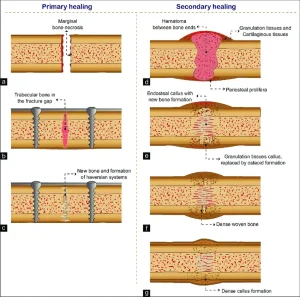
This type occurs in small, clean wounds with closely approximated edges.
Characteristics:
- Regeneration predominates over scarring
- Rapid healing
- Minimal inflammation and scar formation
Examples:
- Minor cuts (e.g., paper cuts)
- Surgical incisions with sutures
- Periodontal flap procedures
2. Healing by Second Intention (Secondary Healing)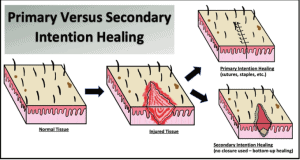
This occurs in large, open wounds where tissue loss is significant.
Characteristics:
- Scar formation predominates
- Slower healing process
- Increased inflammation
- Higher risk of infection
Examples:
- Burns
- Tooth extraction sockets
- Gingivectomy wounds
Abnormalities in Tissue Repair
Impaired or excessive repair processes can lead to pathological conditions:
- Insufficient granulation tissue formation: delayed or incomplete healing
- Excessive scarring (keloids): overproduction of collagen beyond wound boundaries
- Excessive granulation tissue (proud flesh): abnormal tissue overgrowth that interferes with healing
Conclusion
Tissue repair is a complex and highly regulated process involving regeneration and scar formation. The outcome depends largely on tissue type and injury severity. Understanding these mechanisms is essential in clinical practice to improve healing outcomes and manage complications effectively.