
Introduction
Mannose-binding lectin (MBL), also known as mannan-binding protein, is a key component of the innate immune system. It belongs to a group of proteins called collectins, which combine collagen-like regions with carbohydrate-recognition domains. These proteins share a structural motif characterized by repeating Glycine-Xaa-Yaa amino acid sequences, typical of collagen triple helices.
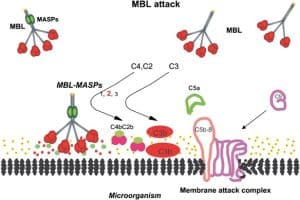
MBL plays a crucial role in first-line host defense by recognizing carbohydrate patterns present on the surface of pathogens such as bacteria, viruses, and fungi. Once bound, it activates the lectin pathway of the complement system, leading to pathogen opsonization and elimination.
Over the past decades, MBL has attracted significant scientific attention due to its potential clinical relevance. Studies suggest that genetic variations affecting MBL serum levels may influence susceptibility to infections, autoimmune disorders, and inflammatory diseases. However, the exact clinical significance remains debated, especially in the general population.
This article focuses on the molecular and genetic basis of MBL variation, rather than clinical outcomes.
Historical Background of MBL Discovery
The importance of MBL was first hinted at in 1968 when a patient exhibited a defect in the phagocytosis of yeast particles. This defect was linked to reduced complement activity, specifically lower deposition of complement component C3 on microbial surfaces.
Later, researchers identified a protein capable of binding to mannan (a carbohydrate found in yeast cell walls). This protein, now known as MBL, was shown to activate the complement system upon binding to microbial surfaces.
Subsequent studies confirmed that MBL deficiency was responsible for impaired immune responses, particularly reduced phagocytosis. Further research revealed that MBL functions in association with enzymes called MBL-associated serine proteases (MASPs), including MASP-1, MASP-2, and MASP-3. Among these, MASP-2 is considered the primary activator of the lectin complement pathway.
Organization of the Human MBL2 Gene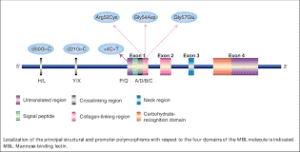
The human MBL protein is encoded by the MBL2 gene, located on chromosome 10 (region 10q11.2–q21). This gene consists of:
- 4 exons (protein-coding regions)
- 3 introns (non-coding regions)
Each exon encodes a specific functional domain:
- Exon 1: Signal peptide and collagen-like domain
- Exon 2: Extended collagen-like structure
- Exon 3: Neck region
- Exon 4: Carbohydrate-recognition domain (CRD)
An interesting feature of the MBL2 gene is the presence of an alternative exon (exon 0) located upstream. Although not translated into protein, it contributes to transcriptional regulation. Most MBL is produced from transcripts starting at exon 1, while a smaller fraction originates from exon 0.
The gene structure highlights the complexity of MBL regulation and its importance in immune function.
Structure of the MBL Protein
The MBL protein has a complex oligomeric structure composed of multiple polypeptide chains. Each chain contains four main domains:
- N-terminal cysteine-rich region
- Involved in oligomer formation through disulfide bonds
-

Collagen-like domain
- Contains repeating Glycine-Xaa-Yaa motifs
- Forms a triple helix structure
- Neck region
- Essential for oligomerization
- Carbohydrate-recognition domain (CRD)
- Binds to sugars such as mannose and N-acetylglucosamine
MBL exists in serum as oligomers, typically trimers and tetramers of triple helices. Higher-order structures (pentamers and hexamers) may also be present.
Although SDS-PAGE analysis often suggests a molecular weight of ~32 kDa per chain, mass spectrometry indicates the actual weight is closer to 25 kDa. This discrepancy is due to the unique structural properties of collagen-like proteins.
Genetic Variations in the MBL2 Gene
Structural Mutations
One of the most important aspects of MBL biology is its high genetic variability, particularly in exon 1 of the MBL2 gene. Three major mutations have been identified:
- Codon 54 mutation (allele B)
- Glycine → Aspartic acid substitution
- Codon 57 mutation (allele C)
- Glycine → Glutamic acid substitution
- Codon 52 mutation (allele D)
- Arginine → Cysteine substitution
These mutations disrupt the collagen-like structure, leading to impaired oligomerization and reduced functional MBL levels.
Because their effects are similar, these variants are collectively referred to as the “O” allele, while the normal allele is termed “A”.
Promoter Polymorphisms
In addition to structural mutations, variations in the promoter region significantly affect MBL expression. Key polymorphisms include:
- Position -550 (H/L variant)
- Position -221 (X/Y variant)
These variations form distinct haplotypes, such as:
- HYA → High MBL levels
- LYA → Intermediate levels
- LXA → Low levels
Additional polymorphisms further refine these haplotypes, contributing to the wide variability in MBL serum concentrations observed among individuals.
Effects of MBL Genetic Variants on Protein Function
Genetic variations in MBL2 primarily affect:
1. Serum Concentration
Individuals carrying variant alleles (B, C, or D) often have significantly reduced MBL levels, especially in homozygous or compound heterozygous states.
2. Protein Structure
Mutations disrupt proper assembly of MBL oligomers, leading to:
- Lower stability
- Reduced functional activity
3. Binding Affinity
Variant MBL proteins show:
- Decreased binding to microbial carbohydrates
- Reduced activation of the complement system
4. Interaction with MASPs
Altered structure may impair interaction with MASP-2, reducing complement activation efficiency.
Despite these limitations, some studies suggest that variant MBL may retain partial biological activity under certain conditions.
Population Distribution of MBL Variants
MBL2 polymorphisms are widely distributed across human populations, often at surprisingly high frequencies.
Examples include:
- High frequency of allele B in certain South American populations
- High frequency of allele C in African populations
- Lower frequencies in Asian populations
In some populations, up to 60% of individuals may carry defective genotypes, raising an important evolutionary question: why are these variants so common?

Evolutionary Significance of MBL Deficiency
The persistence of MBL variants suggests a selective advantage, rather than purely negative effects. Two main hypotheses explain this:

1. Protection Against Excessive Inflammation
Lower MBL levels may reduce excessive complement activation, preventing tissue damage during infections.
2. Reduced Pathogen Exploitation
Some pathogens may use MBL-mediated pathways to enhance infection. Lower MBL levels could therefore provide protection.
This concept is similar to balanced polymorphism, where genetic diversity is maintained because it provides survival advantages under certain conditions.
MBL1 Pseudogene and Evolutionary Insights
Humans possess a second MBL-related gene called MBL1P1, which is a pseudogene (non-functional). It contains mutations such as:
- Stop codons
- Splicing defects
- Amino acid substitutions disrupting protein structure
Interestingly, similar mutations affecting glycine residues are found in both MBL1P1 and MBL2 genes, suggesting parallel evolutionary mechanisms leading to reduced MBL function.
This redundancy implies that MBL function can be compensated by other immune components.
Functional and Experimental Considerations
Accurate measurement of MBL levels can be challenging due to:
- Variability in oligomerization
- Limitations of detection assays
- Differences between structural and functional measurements
Some assays may underestimate MBL levels, especially in individuals carrying variant alleles. Advanced techniques have shown that variant MBL proteins may exist in higher quantities than previously thought, but with altered functionality.
Conclusion
Mannose-binding lectin is a critical component of the innate immune system, linking pathogen recognition to complement activation. The MBL2 gene exhibits complex genetic variation, including structural mutations and promoter polymorphisms that significantly influence protein levels and function.
These genetic variations result in a wide range of MBL activity among individuals and populations. While MBL deficiency can impair immune responses, its high global prevalence suggests important evolutionary advantages, possibly related to balancing immune protection and inflammatory damage.
Understanding the molecular basis of MBL variation provides valuable insights into immune system regulation, genetic diversity, and host-pathogen interactions. Future research will further clarify its role in disease susceptibility and its potential applications in personalized medicine.