

Introduction
Cystic Fibrosis (CF) is a complex, inherited disorder that primarily affects the respiratory, digestive, and reproductive systems. It is caused by mutations in the CFTR gene, which encodes a protein responsible for regulating chloride ion transport across epithelial cells.
Diagnosing cystic fibrosis is not always straightforward. While traditionally considered a clinical disease confirmed by laboratory testing, the wide variability in symptoms and genetic mutations has made diagnosis increasingly complex. Some individuals present with severe symptoms early in life, while others may remain asymptomatic for years or even into adulthood.
As a result, the need for standardized diagnostic criteria and consensus guidelines has become essential in modern clinical practice.
Evolution of Diagnostic Criteria for Cystic Fibrosis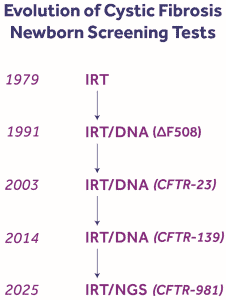
Historically, cystic fibrosis diagnosis relied on clinical observations such as chronic lung disease and malabsorption. Early descriptions of CF date back centuries, but a major breakthrough occurred in 1953 when elevated salt levels in sweat were identified as a hallmark of the disease.
The discovery of the CFTR gene in 1989 revolutionized understanding of CF. It revealed that the disease exists on a spectrum, ranging from classic severe forms to milder or atypical presentations. This va
Diagnostic Consensus Milestones
riability led to the development of formal diagnostic guidelines.
- 1998 North American Consensus: Diagnosis required:
- Clinical symptoms or positive newborn screening
- Plus evidence of CFTR dysfunction (e.g., elevated sweat chloride >60 mmol/L, two CF-causing mutations, or abnormal nasal potential difference)
- 2006 European Consensus:
- Introduced classification into:
- Classic CF
- Atypical (non-classic) CF
- Included intermediate sweat chloride values (30–60 mmol/L)
- Introduced classification into:
- 2008 Updated American Guidelines:
- Removed “atypical CF” terminology
- Adjusted intermediate sweat chloride threshold to ≥40 mmol/L (later revised)
Today, both European and American guidelines largely agree, emphasizing a combination of clinical features and laboratory confirmation.
Clinical Presentation and Diagnostic Challenges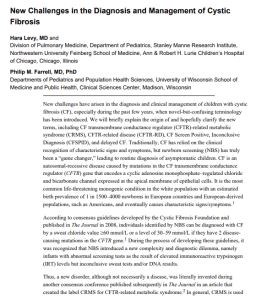
Cystic fibrosis presents with a broad range of symptoms affecting multiple organ systems. Common clinical features include:
- Chronic respiratory infections
- Persistent cough and mucus production
- Malabsorption and steatorrhea
- Failure to thrive in infants
- Male infertility due to absence of vas deferens
However, diagnosis can be challenging because:
- Some patients are asymptomatic at birth
- Newborn screening detects individuals before symptoms appear
- Mild or single-organ disease may not meet full diagnostic criteria
In such cases, additional testing is required to confirm CFTR dysfunction.
Sweat Test: The Gold Standard for Diagnosis
The sweat chloride test remains the most reliable and widely used diagnostic tool for cystic fibrosis.
Principle
In healthy individuals, chloride is reabsorbed in sweat ducts via CFTR channels. In CF patients, defective CFTR function leads to elevated chloride levels in sweat.
Procedure
- Sweat is stimulated using pilocarpine iontophoresis
- Collected using gauze, filter paper, or microcoil devices
- Chloride concentration is measured
Interpretation
- >60 mmol/L: Diagnostic for CF
- 30–60 mmol/L: Intermediate (requires further testing)
- <30 mmol/L: Unlikely CF
Limitations
- Difficult sample collection in newborns
- Variability due to environmental and genetic factors
- Rare false positives (e.g., endocrine disorders)
Despite these limitations, the sweat test remains central to CF diagnosis.
Genetic Testing and CFTR Mutation Analysis
Genetic testing plays a crucial role in confirming cystic fibrosis, especially in borderline cases.
CFTR Mutation Diversity
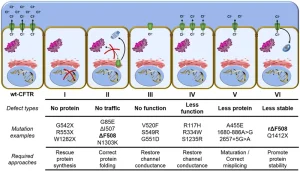
More than 2,000 mutations in the CFTR gene have been identified. These mutations vary in severity and functional impact, contributing to the wide clinical spectrum of CF.
Diagnostic Role
- Identification of two disease-causing mutations confirms CF
- Used in newborn screening programs
- Helps predict disease severity and guide treatment
Databases such as CFTR2 provide detailed information on mutation-specific clinical outcomes, including lung function and pancreatic involvement.
Functional Tests of CFTR Activity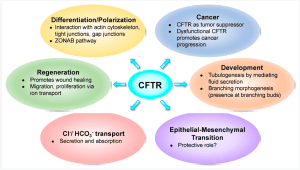
When standard tests are inconclusive, functional assays are used to assess CFTR activity directly.
Nasal Potential Difference (NPD)
NPD measures electrical potential across nasal epithelium.
- CF patients show:
- Increased sodium absorption
- Reduced chloride secretion
This test is useful but has limitations:
- High variability
- Requires specialized expertise
- Limited availability
Intestinal Current Measurement (ICM)
ICM evaluates ion transport in rectal biopsy samples.
- Measures chloride secretion in response to stimulation
- Clearly distinguishes CF from non-CF individuals
Advantages:
- High diagnostic accuracy
- Useful in ambiguous cases
Limitations:
- Invasive procedure
- Requires specialized laboratory setup
Newborn Screening for Cystic Fibrosis
Newborn screening (NBS) has transformed early detection of cystic fibrosis.
Screening Process
- Initial test: Immunoreactive trypsinogen (IRT) measurement
- Follow-up tests:
- CFTR mutation analysis
- Repeat IRT or protein markers
Benefits
- Early diagnosis (often before symptoms)
- Improved clinical outcomes
- Reduced diagnostic delay
Challenges
- False positives and inconclusive results
- Detection of carriers or mild cases
- Psychological impact on families
Some infants fall into a category known as CF screen positive inconclusive diagnosis (CFSPID), requiring long-term monitoring.
CFTR-Related Disorders (CFTR-RD)
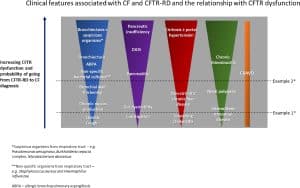
Not all individuals with CFTR dysfunction meet criteria for cystic fibrosis.
CFTR-related disorder includes conditions such as:
- Congenital absence of vas deferens
- Recurrent pancreatitis
- Bronchiectasis
These individuals show partial CFTR dysfunction but lack full diagnostic criteria for CF. Proper differential diagnosis is essential to exclude other diseases.
Emerging Diagnostic Technologies
Beta-Adrenergic Sweat Test
This advanced test evaluates CFTR-dependent sweat secretion by comparing responses to different stimuli.
- Provides quantitative assessment of CFTR function
- Potential biomarker for treatment response
Organoid-Based Testing
Organoids are 3D cell cultures derived from patient tissue.
- Mimic intestinal structure and function
- Used to assess CFTR activity via swelling assays
- Enable personalized diagnosis and treatment prediction
This technology represents a major advancement in precision medicine for CF.
Diagnosis in Adults
Contrary to earlier beliefs, cystic fibrosis is not limited to children. Increasingly, adults are being diagnosed with CF.
Characteristics of Adult Diagnosis
- Milder symptoms
- Pancreatic sufficiency
- Non-classic mutations
Common presentations include:
- Chronic respiratory symptoms
- Male infertility
- Recurrent infections
Diagnosis in adults often ends years of uncertainty and allows initiation of targeted therapy.
Communicating the Diagnosis
Delivering a diagnosis of cystic fibrosis is a critical moment for patients and families.
considerations:
- Provide clear, accurate information
- Address emotional impact
- Offer ongoing support and follow-up
Parents of newborns diagnosed through screening may experience shock, denial, or anxiety, especially if the child appears healthy.
At the same time, advances in treatment offer hope:
- Life expectancy has significantly improved
- Targeted therapies are available for specific mutations
- Ongoing research continues to expand treatment options
Conclusion
The diagnosis of cystic fibrosis has evolved from a purely clinical assessment to a complex, multi-step process integrating clinical features, biochemical testing, genetic analysis, and functional assays.
While the majority of cases are diagnosed بسهولة using standard criteria, a subset of patients requires advanced diagnostic approaches due to atypical presentations or inconclusive results.
With the integration of newborn screening, molecular diagnostics, and emerging technologies such as organoids, the future of CF diagnosis is moving toward earlier detection, greater accuracy, and personalized care.
Ultimately, a precise and timely diagnosis is essential for improving outcomes and quality of life for individuals affected by cystic fibrosis.