

Introduction
Inflammation is a fundamental biological process that plays a critical role in protecting the body against infections, tissue damage, and environmental stressors. Acute inflammation, in particular, is a rapid and beneficial immune response that promotes pathogen elimination and tissue repair. However, as organisms age, the immune system undergoes profound changes that alter both the intensity and regulation of inflammatory responses.
One of the most important age-related phenomena is inflammaging, a term used to describe a chronic, low-grade, systemic inflammatory state that develops progressively over time. Unlike acute inflammation, inflammaging is persistent and often dysregulated, contributing to tissue damage rather than protection. At the same time, aging is associated with immunosenescence, a gradual decline in immune system function affecting both innate and adaptive immunity.
Together, inflammaging and immunosenescence significantly increase susceptibility to infections, reduce vaccine efficacy, and promote the development of age-related diseases such as type 2 diabetes, cardiovascular disease, osteoporosis, rheumatoid arthritis, and neurodegenerative disorders.
Circulating inflammatory mediators—including cytokines and acute-phase proteins such as C-reactive protein (CRP) and mannose-binding lectin (MBL)—serve as key biomarkers of this chronic inflammatory state. Understanding the molecular and cellular mechanisms driving inflammaging is essential for developing targeted strategies to improve immune function and health outcomes in aging populations.
Genetic Regulation of Inflammaging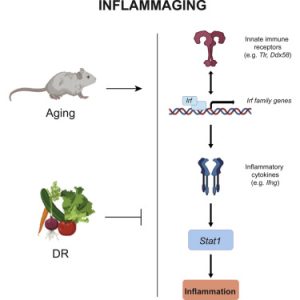
Genetic factors play a crucial role in determining the intensity of inflammaging. In particular, single nucleotide polymorphisms (SNPs) in the promoter regions of cytokine genes can significantly influence the production of pro- and anti-inflammatory mediators.
For example, polymorphisms in the IL-6 gene promoter (such as the -174 C/G SNP) regulate circulating IL-6 levels. Individuals carrying the GG genotype typically exhibit higher IL-6 production, which is associated with increased inflammation, reduced longevity, and higher mortality risk following cardiovascular events. Interestingly, these effects appear to be more pronounced in men than in women.
Similarly, polymorphisms in the interferon-gamma (IFN-γ) gene influence immune responses. The -874 T/A SNP affects transcriptional regulation via NF-κB binding sites. The A allele, associated with lower IFN-γ production, has been linked to increased longevity, suggesting that reduced pro-inflammatory signaling may confer survival advantages.
In contrast, polymorphisms in anti-inflammatory genes such as IL-10 show the opposite trend. The -1082 GG genotype, associated with higher IL-10 production, is more frequently observed in centenarians. These findings collectively indicate that genetic profiles favoring anti-inflammatory responses are positively associated with longevity, whereas pro-inflammatory genotypes may accelerate aging-related decline.
Chronic Infections and Immune System Remodeling
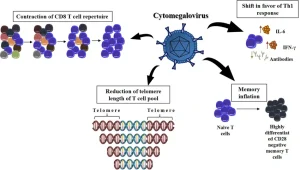
One of the major drivers of inflammaging is chronic immune stimulation caused by persistent viral infections, particularly cytomegalovirus (CMV). CMV is a widespread herpesvirus that establishes lifelong latency after infection and continuously interacts with the immune system.
CMV infects multiple cell types, including fibroblasts, endothelial cells, and epithelial cells, leading to constant antigen presentation via MHC class I molecules. This persistent stimulation results in sustained activation of immune cells and continuous production of pro-inflammatory cytokines.
A key molecular mechanism involves activation of the NF-κB signaling pathway, which promotes the production of tumor necrosis factor-alpha (TNF-α). TNF-α, in turn, can reactivate latent CMV, creating a self-amplifying inflammatory loop that exacerbates systemic inflammation.
Although other chronic viral infections such as hepatitis B and C can induce inflammation, their effects are typically localized to specific organs and contribute less to systemic inflammaging compared to CMV.
Cellular Senescence and the SASP Phenotype
Cellular senescence is another major contributor to inflammaging. Senescent cells accumulate with age and adopt a characteristic senescence-associated secretory phenotype (SASP). This phenotype is defined by the secretion of pro-inflammatory cytokines, chemokines, growth factors, and proteases.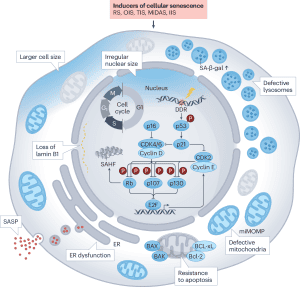
Senescence can be triggered by multiple stressors, including:
- Telomere shortening
- DNA damage and mutations
- Oxidative stress (ROS production)
- Protein aggregation
- Excessive cell proliferation
These stressors activate tumor suppressor pathways such as p53 and p16INK4a, leading to irreversible cell cycle arrest. At the same time, signaling pathways involving NF-κB, TGF-β, IL-1, and IL-6 promote the development of the SASP.
The accumulation of senescent cells creates a pro-inflammatory microenvironment that contributes to the development of age-related diseases, including cancer. In tumor settings, senescent cells can enhance tumor progression by influencing immune cell behavior, particularly by promoting pro-tumoral macrophage phenotypes and suppressing effective anti-tumor responses.
Metabolic Factors and Obesity-Driven Inflammation
Metabolic changes, especially increased adiposity, are strongly associated with inflammaging. Obesity is now recognized as a chronic inflammatory condition characterized by continuous activation of the innate immune system.
In obese individuals, adipose tissue becomes infiltrated with immune cells, including macrophages and T lymphocytes. These cells produce pro-inflammatory cytokines that contribute to both local and systemic inflammation.
A key feature of obesity-related inflammation is the shift in immune cell balance:
- In lean individuals: anti-inflammatory cells (Th2 CD4+ T cells, regulatory T cells, M2 macrophages) dominate
- In obese individuals: pro-inflammatory cells (Th1 CD4+ T cells, CD8+ T cells, M1 macrophages) are predominant
This imbalance promotes insulin resistance and contributes to metabolic diseases such as type 2 diabetes. Moreover, obesity-related inflammation has been shown to reduce vaccine efficacy and impair immune responses to infections.
Role of MicroRNAs and Mitochondrial DNA
Recent studies have identified microRNAs (miRNAs) as important regulators of inflammaging. A subset known as “inflamma-miRs” is upregulated during aging and enhances inflammatory signaling by activating toll-like receptors (TLRs) and the NF-κB pathway.
Additionally, mitochondrial DNA (mtDNA) released into circulation acts as a damage-associated molecular pattern (DAMP). Elevated levels of circulating mtDNA correlate with increased pro-inflammatory cytokines, further contributing to chronic inflammation.
Gut Microbiota and Intestinal Barrier Dysfunction
The gut microbiome plays a critical role in immune regulation, and its composition changes significantly with age. Elderly individuals typically exhibit reduced levels of beneficial bacteria such as Bifidobacteria and increased levels of opportunistic pathogens.
These changes are associated with elevated systemic inflammation. Furthermore, aging is linked to increased intestinal permeability due to weakened epithelial barriers. This allows bacterial components such as lipopolysaccharides (LPS) to enter the bloodstream, triggering immune activation and sustaining inflammaging.
Impact of Aging on T Cell Function
T cells are central to adaptive immunity, and their function declines significantly with age. Key features of T cell immunosenescence include:
- Reduced numbers of naïve T cells
- Accumulation of memory and effector T cells
- Loss of CD28 expression
- Increased presence of senescent T cell populations
Chronic infections like CMV contribute to T cell exhaustion, reducing their ability to respond to new antigens. This leads to impaired vaccine responses and increased susceptibility to infections.
In elderly individuals, increased production of anti-inflammatory cytokines such as IL-10, combined with reduced IFN-γ levels, further suppresses T cell-mediated immunity.
B Cell Dysfunction and Reduced Antibody Responses
Aging also affects B cell function, leading to decreased antibody production. Key defects include:
- Reduced class switch recombination (CSR)
- Decreased expression of activation-induced cytidine deaminase (AID)
- Lower frequencies of memory B cells
These impairments result in weaker responses to vaccines and infections. Chronic inflammation, particularly elevated TNF-α levels, plays a central role in inhibiting B cell function.
Interestingly, blocking TNF-α has been shown to restore B cell activity, suggesting potential therapeutic strategies to improve immune responses in the elderly.
Innate Immune Cell Dysfunction
Innate immune cells such as macrophages and dendritic cells also exhibit age-related defects. These include:
- Reduced cytokine production in response to stimulation
- Decreased expression of toll-like receptors (TLRs)
- Impaired signaling through NF-κB and MAPK pathways
Dendritic cells from elderly individuals show diminished ability to activate T cells, leading to weaker adaptive immune responses.
Inflammaging and Vaccine Inefficacy
One of the most clinically relevant consequences of inflammaging is reduced vaccine efficacy. Chronic inflammation interferes with both innate and adaptive immune responses, resulting in:
- Lower antibody production
- Reduced T cell activation
- Impaired memory cell formation
Factors such as CMV infection, obesity, and metabolic disorders further exacerbate this problem, making elderly individuals more vulnerable to infectious diseases despite vaccination.
Conclusion
Inflammaging represents a complex and multifactorial process driven by genetic, environmental, metabolic, and immunological factors. It is characterized by chronic systemic inflammation and is closely linked to immunosenescence, leading to impaired immune responses in both mice and humans.
Key contributors include genetic polymorphisms, chronic viral infections, cellular senescence, obesity, gut microbiota alterations, and mitochondrial dysfunction. These factors collectively disrupt the function of immune cells, including T cells, B cells, macrophages, and dendritic cells.
Understanding the mechanisms underlying inflammaging is essential for developing targeted interventions aimed at reducing chronic inflammation, enhancing immune function, and improving vaccine responses in aging populations. Future therapeutic strategies may include modulation of inflammatory pathways, microbiome-based interventions, and personalized medicine approaches based on genetic and immunological profiling.