
Introduction: Why Tau Biomarkers Matter in Alzheimer’s Research
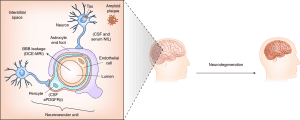
Alzheimer’s disease (AD) is one of the most prevalent and devastating neurodegenerative disorders worldwide, characterized by progressive cognitive decline, memory loss, and functional impairment. As global populations age, the need for early diagnosis, accurate monitoring, and effective therapeutic strategies has become increasingly urgent.
In response to this challenge, the National Institute on Aging Biomarker Working Group proposed a standardized framework for identifying and validating reliable biomarkers for AD. Among the most promising candidates are tau-related biomarkers, particularly total tau (t-tau) and phosphorylated tau (p-tau) proteins measured in cerebrospinal fluid (CSF).
These biomarkers play a crucial role in:
- Early disease detection
- Patient stratification in clinical trials
- Monitoring disease progression
- Evaluating therapeutic efficacy
This article provides a comprehensive overview of tau proteins as biomarkers, their biological relevance, analytical challenges, clinical applications, and future perspectives.
Understanding Tau Protein and Its Role in Neurodegeneration
Tau is a microtubule-associated protein primarily expressed in neurons, where it stabilizes microtubules and supports axonal transport. It is especially abundant in brain regions involved in memory, such as the hippocampus and limbic cortex.
Tau Pathology in Alzheimer’s Disease
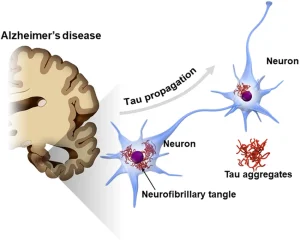
One of the defining pathological features of AD is the presence of neurofibrillary tangles (NFTs), composed of hyper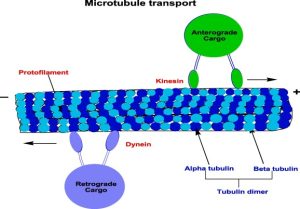 phosphorylated tau protein. Under pathological conditions:
- Tau becomes excessively phosphorylated
- It detaches from microtubules
- Microtubule stability is compromised
- Axonal transport is disrupted
- Tau aggregates into paired helical filaments (PHFs)
This cascade contributes directly to neuronal dysfunction and cell death.
Tau pathology is part of a broader group of disorders known as tauopathies, which include:
- Alzheimer’s disease
- Frontotemporal dementia
Although tau phosphorylation plays a physiological role in brain development, in the adult brain it is strongly associated with neurodegeneration.
Molecular Complexity of Tau: A Challenge for Biomarker Development
The use of tau as a biomarker is complicated by its high molecular heterogeneity:
- Six isoforms generated by alternative mRNA splicing
- Numerous post-translational modifications:
- Phosphorylation
- Glycosylation
- Oxidation
- Nitration
There are up to 79 potential phosphorylation sites, with dozens already identified. This diversity makes it difficult to standardize assays and interpret results.
Additionally, tau concentrations in CSF are relatively low:
- ~300 ng/L in healthy individuals
- ~900 ng/L in AD patients
Despite these challenges, advances in analytical techniques such as mass spectrometry, immunoprecipitation, and ELISA (enzyme-linked immunosorbent assay) have enabled reliable measurement and characterization of tau proteins.
Total Tau (t-tau): A Marker of Neuronal Damage
What is Total Tau?
Total tau (t-tau) refers to the overall concentration of tau protein in CSF, regardless of its phosphorylation state.
Diagnostic Performance
Studies consistently show that:
- t-tau levels are significantly elevated (≈300%) in AD patients
- Sensitivity and specificity range between 80–90% when distinguishing AD from healthy controls
However, t-tau is not disease-specific.
Limitations of t-tau
Elevated t-tau is also observed in:
- Stroke
- Traumatic brain injury
- Creutzfeldt-Jakob disease
- Other neurodegenerative disorders
This indicates that t-tau is a general marker of neuronal injury, particularly reflecting cortical axonal degeneration, rather than a specific indicator of AD.
Phosphorylated Tau (p-tau)
What is p-tau?
Phosphorylated tau (p-tau) refers to tau protein modified at specific phosphorylation sites. The most studied isoforms include:
- p-tau181
- p-tau231
- p-tau199
Clinical Relevance
Unlike t-tau, p-tau shows higher specificity for Alzheimer’s disease.
Key findings include:
- Elevated p-tau distinguishes AD from other dementias
- It correlates with neurofibrillary tangle burden
- It reflects disease-specific pathology rather than general neuronal damage
Diagnostic Advantages
p-tau can differentiate AD from:
- Frontotemporal dementia
- Dementia with Lewy bodies
- Vascular dementia
- Major depression
This makes p-tau a key biomarker for differential diagnosis.
Combining Biomarkers: A More Powerful Diagnostic Approach
While t-tau and p-tau are valuable individually, their combined use significantly improves diagnostic accuracy, especially when integrated with:
- Amyloid-beta (Aβ42) levels
- Genetic markers such as APOE genotype
The Core Biomarker Panel
The widely accepted “core” biomarker panel includes:
- t-tau
- p-tau
- Aβ42
This combination enables:
- Early detection of AD in patients with mild cognitive impairment (MCI)
- Prediction of progression from MCI to AD
- Diagnostic accuracy exceeding 80% predictive value
Role of Tau Biomarkers in Disease Progression
Tau biomarkers are not only diagnostic tools but also indicators of disease progression.
Observations
- p-tau levels correlate with cognitive decline
- Both t-tau and p-tau predict rate of disease progression
- p-tau is associated with hippocampal atrophy
These findings suggest that tau biomarkers reflect ongoing neurodegeneration and can be used to monitor disease evolution over time.
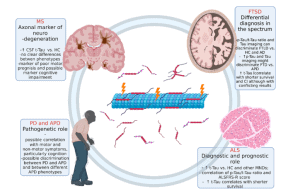
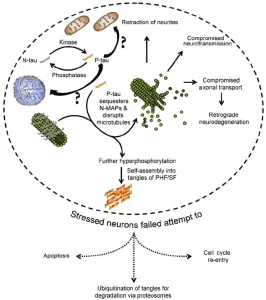
Tau and Molecular Mechanisms of Neurodegeneration
Tau pathology is closely linked to several molecular processes:
Mechanisms
- Hyperphosphorylation
- Driven by kinases such as:
- Glycogen synthase kinase 3 (GSK-3)
- Cyclin-dependent kinase 5 (CDK5)
- Reduced activity of phosphatases like PP2A
- Driven by kinases such as:
- Loss of Microtubule Stability
- Leads to impaired neuronal transport
- Protein Aggregation
- Formation of toxic intracellular inclusions
- Interaction with Amyloid Cascade
- Tau pathology is often considered downstream of amyloid-beta toxicity
However, tau abnormalities alone can drive neurodegeneration, as seen in primary tauopathies.
Tau Biomarkers in Clinical Trials
Applications in Drug Development
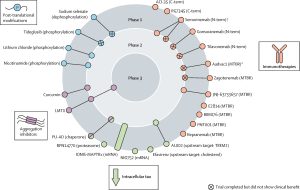
Tau biomarkers are increasingly used in clinical trials for:
- Patient selection and stratification
- Monitoring biological response to treatment
- Evaluating disease-modifying therapies
Challenges in Clinical Trials
Despite their promise, several limitations remain:
- Unclear relationship between biomarker changes and clinical improvement
- Variability in assay methods
- Lack of validated surrogate endpoints
Case Studies
Some clinical trials targeting amyloid or tau pathways have shown:
- Reduction in CSF tau levels
- No clear clinical benefit
This highlights the complexity of linking biochemical changes to functional outcomes.
Tau Detection Beyond CSF: The Potential of Blood-Based Biomarkers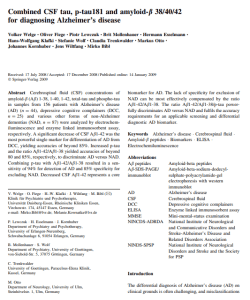
Although CSF remains the gold standard, there is growing interest in blood-based tau biomarkers.
Advantages of Blood Testing
- Less invasive than lumbar puncture
- More suitable for large-scale screening
- Easier implementation in clinical practice
Current Limitations
- Low concentration of tau in blood
- Possible contamination from peripheral sources
- Limited assay sensitivity
Preliminary studies show promise, but further validation is required before routine clinical use.
Future Perspectives: Toward Precision Medicine in Alzheimer’s Disease
The future of AD diagnosis and treatment lies in integrated biomarker approaches.
Emerging Trends
- Combination of biochemical and imaging biomarkers
- Use of MRI and PET scans alongside CSF markers
- Molecular classification of neurodegenerative diseases
Toward Personalized Medicine
By combining:
- Tau biomarkers
- Amyloid markers
- Genetic profiling
Researchers aim to:
- Identify at-risk individuals early
- Tailor treatments to specific disease mechanisms
- Improve clinical trial design
Conclusion
Total tau (t-tau) and phosphorylated tau (p-tau) proteins represent cornerstones in the biomarker landscape of Alzheimer’s disease.
- t-tau serves as a marker of general neuronal damage
- p-tau provides higher specificity for AD pathology
- Combined biomarker panels significantly enhance diagnostic accuracy
While important challenges remain—particularly in standardization, interpretation, and clinical translation—tau biomarkers are already transforming how AD is diagnosed, monitored, and studied.
As research advances, these biomarkers will play a central role in:
- Early detection
- Disease monitoring
- Development of disease-modifying therapies
Ultimately, integrating tau biomarkers into clinical practice brings us closer to effective prevention and personalized treatment strategies for Alzheimer’s disease.